
Theatre Green BUILDINGS Toolkit – Seating Replacement
With thanks to Race Furniture and Charcoalblue International Ltd
As the built environment contributes to almost 40% of the UK’s total CO2 footprint, our industry must collectively work towards reducing our impact on the environment. Narrowing this down, over a building’s life cycle, furniture is responsible for 30% of the CO2 emissions.
To help advise on how to reduce the impact of the furniture, this toolkit draws on existing themes within the Theatre Green Book, to apply them to seating.
To start with, let’s get to know a Theatre seat. Every seat is comprised of 6 elements.
- The Frame
- The frame of seats should be your longest lasting element. If you have an existing seat and depending on the age of your seat, frames can be made from Cast iron, steel and aluminium.
- Fabric
- The fabric or upholstery is the part of the seat that has the most contact with the user and therefore the element that will need replacing more often. Fabrics can range from leather to wool.
- Foam
- Foam is used in every seat and will be found on the seat pan and seat back rest. There are different types of foam used depending on the seating manufacturer.
- Finishes
- The finishes on your seat are those which may be seen on the back of the seat, under the seat pan, and the arms. These range from solid timber to veneers.
- Tip up mechanism
- This part of the seat ensures that the seat pan tips up when the user stands up. Common examples of these are sprung or counterweight mechanisms
- Signage
- Row letters, seat numbers and sponsor plates may all feature on seats. These come in all shapes and sizes and finishes from embroidered numbers to brass sponsor plates.
Now you know your seat, you need to ask yourself a few questions:
- What is the condition of your seats?
- Are the seats still comfortable? Is the fabric frayed or worn? Do all of the seats still tip back up when not in use? Are there unsightly scratches to the finishes? Is there damage to the frame?
- What is the age of the seats?
- Do you know when the seats were installed? Are they of a certain era or have any historical designs on them to help you identify their age?
- If your building is listed consider whether the seats are a part of the listing and will require listed building consent for repair and / or replacement.
- Are the seats still fit for purpose?
- Do you get complaints about the position of the seats (are they too small, lack of legroom, or bad sightlines), are you using your venue differently to how it was originally designed? Do the seats have to be removed/reconfigured a lot despite not being designed to do so?
If you don’t feel confident enough to answer these questions, then you have a few options. If you know who manufactured your seats or have an existing maintenance contract with a seating supplier, then they can do this assessment for you. You may opt to employ a Theatre consultant or another Seating Manufacturer to do this job too. Whichever option you choose, answering these questions will help you understand if you need to change all of your seats or just refurbish them.
Relating to Sustainable Productions Toolkit Ruse and Recycling, if you do take the more sustainable option of reusing your seats then a new fabric/finish can often have the same visual impact on the space as completely replacing the seating. Often the framework of the seating is still fit for purpose, while the foam, upholstery and wood finishes are more susceptible to wear and tear and will be the areas needing attention.
Before making the big decision to change all of your seats consider the whole lifecycle of the product. Each section of the product lifecycle may have a knock-on effect on the next.
- Product design
- Procurement
- Manufacturing
- Delivery
- Use & longevity
- End-of-life

Seating Layout
If you have made the decision for a full replacement, then you’ll also need to consider the seating layout.
The seating design is directly related to the layout of the seating. Consider how your current layout affects the form and make up of the chair and ways you want to change this.
Consider a holistic view while designing the seating layout. A multifunctional space can increase the usability of the theatre and reduce the need for a complete renovation or alternations over the following years. Removable and reconfigurable seating is available and can be designed to work with the space available in the theatre and may potentially be shared with other spaces within the theatre building. This would thereby reduce the amount of redundant furniture and storage space required.
When designing the space, consider the modularity and common parts throughout the theatre. The reduction in complexity and parts reduces the materials and manufacturing processes, resulting in lower energy demands. This also simplifies repairs and ongoing maintenance.
If refurbishment is not an option, can the existing seating be reused or repurposed for other areas in the theatre or on another local project? The repurposing of the furniture increases the product life span and redirects potential waste; as explained in section 6 of the life cycle approach.
Refurbishment and reusing seats
Refurbishment of seats should always be the first option before making the decision to design and install new seats. Many elements of the seats can be refurbished and reused. In particular the metal framework can often be re-finished and reused with a new seat.
Seating design
So, you now have a seating layout, you’ll now need to look at the design of the seats.
Firstly, discuss with your stakeholders the importance of sustainability when designing and selecting seats. As previously mentioned, if the end-of-life is considered at the start of design; products will be designed for disassembly to aid separation to either be repaired, disposed of responsibly or remanufactured.
Early on consider using the following as part of your design:
- Recycled content of materials
- Recyclability or reuse of materials
- Efficiency of design – cut down on unnecessary materials/finishes/features
- CO2 emissions of materials i.e., Recycled steel over Virgin steel
The data can then be used to calculate the percentage of the entire product (e.g., by mass or volume) which is recycled or recyclable. There are currently many different methods to do this so speak with your advisor/consultant/manufacturer for more information about this.
When choosing the components within your seating with the above in mind, also consider the longevity of the material type and the repairability as detailed in full below. In addition, consider the whole seating layout design, to ensure you are thinking holistically about the space.
Longevity
Consider the lifespan of the chairs and whether their ability to be repaired and refurbished could extend this lifespan. For example, the chair frame (if made from a durable material such as steel) could last 30 years, whereas the seat and back, typically made of less durable materials, are more likely have a lifespan of 10-15 years. If these parts can be repaired and refurbished, the life of the chair can be extended.
By considering the design and durability of each individual seating components, the need for refurbishment can be reduced. For example, consider where the key wearing points of the seats are and how these areas can be reinforced (as explained below). Further to this, are there seats or areas of the auditorium that see more use/action than others? For example, production desk positions; do these seats get removed regularly or have desks mounted over them? Consider if you might need additional covers made or to have quick release floor fixings to enable fast and easy removal/replacement.
Also, when planning the spares package, be aware that these quick-to-wear parts should be included to ensure you are able to repair more simple components. The key spare seat components advised would be:
- Armrests
- End of row panels
- Back upholstery panels
- Seat pan upholstery panels
Quantities would be dependent on the seating layout and frequency of use; and would be in addition to spare fixings, signage, materials, touch up paint etc.
Upholstery
Seating upholstery is the first area to show wear and tear as the fabric is the least durable of the materials and is used in areas of the chair with the most contact and abrasion.
When developing the design of your seating, softer edges and corners are more forgiving and will wear slower than sharp edges, especially when the fabric and foam is pulled tight.
Material choice can also assist in improving the durability – and therefore lifespan – of the chair. Typically, leather is used due to its durability. Today there is the debate about the sustainability of leather due to its resource intensive production. Consider the material, the CO2 footprint of fabrics, the durability and the end-of-life disposal of each material to find which is most suitable and sustainable for use. On the corners of seating, consider a hardwearing fabric to stop it wearing as quickly. If leather is considered the most appropriate fabric due to it being in a high contact area, could you consider panels of leather, whilst upholstering the rest of the seat in a different fabric to reduce the amount you need?
Also, think about where the fabric comes from, is it locally sourced or does it get flown/shipped across the world? China, Australia and New Zealand are the leading producers in wool whilst Italy, Brazil and China are the leading producers in Leather. Materials should be sourced locally where at all possible. There are also now great low carbon plant based materials coming onto the market like Flax and Hemp.
When selecting seat fabric colours and patterns, the colour, pattern and finish should be carefully selected to disguise stains, marks and signs of wear and tear.
Finally, the maintenance and cleaning of the fabric is an important factor to ensure that any stains and spills are relatively easy to remove. You don’t want to go for a lovely low carbon fabric but it requires large amounts of maintenance, cleaning or a harmful protective coating.
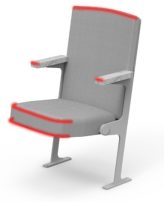
Upholstery Key Wear Areas:
- Armrests (if upholstered)
- Front edge and corners of seat
- Top edge and corners of backrest
Timber
Following the upholstery, the next most common area to need replacing are stained or painted timber components. Armrests or handholds, where the user is commonly making contact with the seating, will show wear in the form of fading, scratches or dents in the stain or paintwork.
These parts can be replaced over time, however they still tend to have a longer lifespan than an upholstered alternative. To improve the lifespan further, a solid wood armrest which has only an oil or clear lacquer finish will visually appear newer for longer and can easily be touched up. Unstained solid wood arms may be more costly but will not show wear in the same way stained or painted timber would.
Timber should also be carefully selected to ensure that it is sourced from sustainable forests and is locally produced where possible.
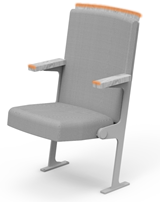
Timber Key Wear Areas:
- Armrests (if stained)
- Top edge and corners of backrest – especially with an upstand (if stained)
Metalwork
The metal framework of the seating is the most durable component, and will last longest if made from powder-coated steel or similar. Energy efficient and low-cure powder coating treatment should be considered utilising 100% post consumer plastics where available. Similarly, metal produced using electric-arc furnaces should be used where possible.
The plastic powder coating is a protective coating that is resistant to scratches and scrapes and so the metalwork can last for years; and as long as it is kept clean it will likely only need the paintwork touched up. These elements will therefore dictate the total possible lifespan of the furniture.
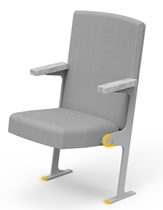
Metal frame Key Wear Areas:
- Baseplates
- Front edge of frame
- Areas that are damaged during storage and transportation (removable chairs)
Foam
Foam is needed in nearly every upholstered seat. Depending on the frequency of use, the foam can last 10-15 years but sometimes as long as 20 years. There has been research to look at different sources of foam but on the whole, foam remains the most used material as the cushioning for seats.
Density and depth of foam should be carefully considered to ensure the design life is maximised without degrading and the fabric sagging. The form of the chair should be optimised to offer the best support of users, without only relying on foam.
Virgin polyurethane foam should be used as little as possible, and alternatives explored provided they offer the comfort, aesthetic and design life required.
How can the seating be disassembled?
Designing a product that can be disassembled links back to the possibility of future refurbishment. It takes into consideration the entire product lifecycle and can be beneficial for cost, transportation, and the environment.
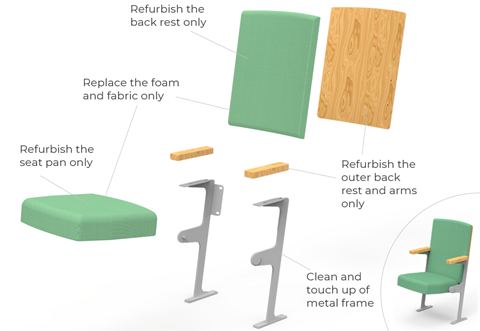
In practice:
- Reduced/No adhesives
- Investigate different upholstery methods with the chosen seating manufacturer. Some adhesives may be necessary to hold the foam in place, however there are ways to reduce or minimise adhesives in the upholstery process such as mechanical fixings.
- Opt for non-adhesive fixings when choosing the signage, options such as woodscrews and magnets are preferable over glues or tape, this reduces the use of single use products in the short term and allows the signage to be replaced independently of other areas of the furniture.
- Speak with your seat designer and manufacturer about the use of VOCs (Volatile Organic Compounds) in the seat. Examples of these are coatings for fire, stain resistance, stains, sealants and adhesives. Every manufacturer should be open with the types they use and their plans to reduce and stop using them.
- Maintenance
- Seating that can be disassembled allows for the furniture to be maintained more easily – this may be a refurbishment further down the line or day-to-day internal maintenance. Taking care of the seating and replacing only the worn parts will mean that you can extend the furniture’s lifespan and prevent it from going to waste for longer.
- Request a spares package to be supplied as part of the seating order. Having spare parts for the seating when ordering furniture not only enables quicker and easier maintenance, but also means that the materials, processes and transportation is included in the main order and therefore has a lower environmental impact
- If a self-tipping seat is required, explore the mechanism options with your seating manufacturer to ensure that the mechanism is serviceable and/or has a long-life span as moving parts will wear out quicker than the rest of the seating. Typically, a counterweight mechanism outlasts a sprung mechanism.
- Delivery
- A product that can be easily disassembled allows the packaging to be more compact as parts can be packaged together. This reduces the environmental impact of delivery by reducing the number of journeys required.
- Packaging materials should be recyclable or reusable. Plastic and expanded polystyrene products should be avoided.
- Delivery should allow for the most energy-efficient transportation method available prior to installation. Transportation by air should be avoided.